Living systems
Kritikk, Reviews, Eso Malflor 10.11.2026
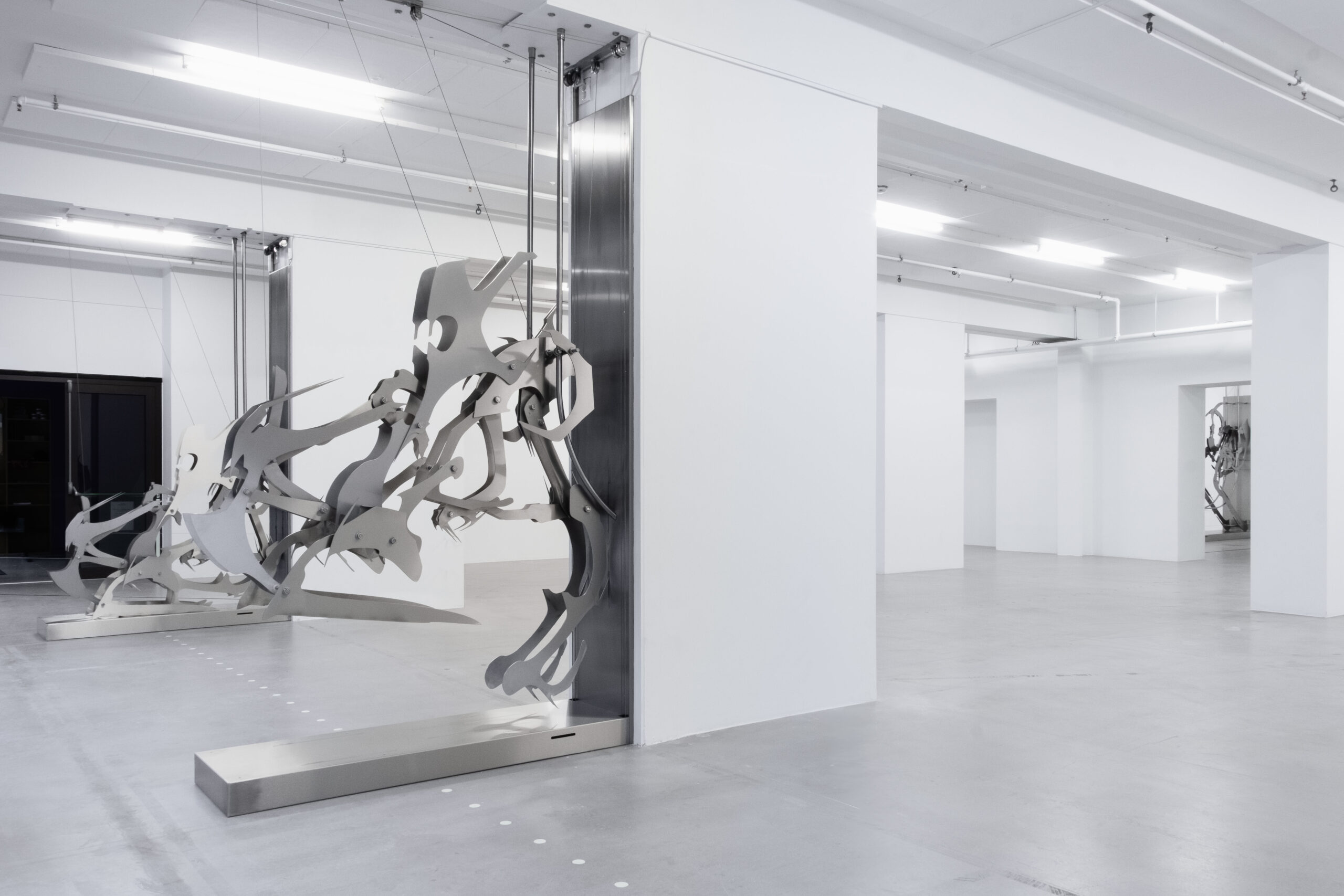
The Barren is a solo exhibition by Netherlands-based artist Isabelle Andriessen at Kunsthall Trondheim, exploring themes of technology, the body, and control through large-scale steel kinetic sculptures. Upon entering the gallery, I am immediately met by one of the works placed near the windows, roped off by a wire that forces me to keep my distance. The material, the intermittent clanging of steel, and the sheer scale of the sharp, insect-like forms ignite my curiosity and desire to come closer, yet this barrier keeps me away for my own safety.
Stepping further into the room, the scale of the gallery space calls attention to its sparseness. The main gallery feels somewhat underutilized, though this emptiness underscores an isolated tone within the works. Two of the sculptures stand parallel, facing the windows and the city just outside. One is never fully able to face the works directly; we are forced to stand beside them, behind them, just out of reach. Because we the audience are unable to look them in the eye, so to speak, and are instead confined to the margins, we are no longer mere observers – we are firmly positioned alongside them.
A soundscape fills the mostly empty gallery, an ambient score for the choreography played out by the kinetic sculptures. Steel is often equated to sterility, skyscrapers, industry, and the non-natural or non-human. Yet we forget that the origins of steel, iron and carbon, come from the core of the very earth we stand upon. Andriessen’s sculptural forms remind us of these organic origins: they are alive, moving, and fraught with the potential for both creation and harm.
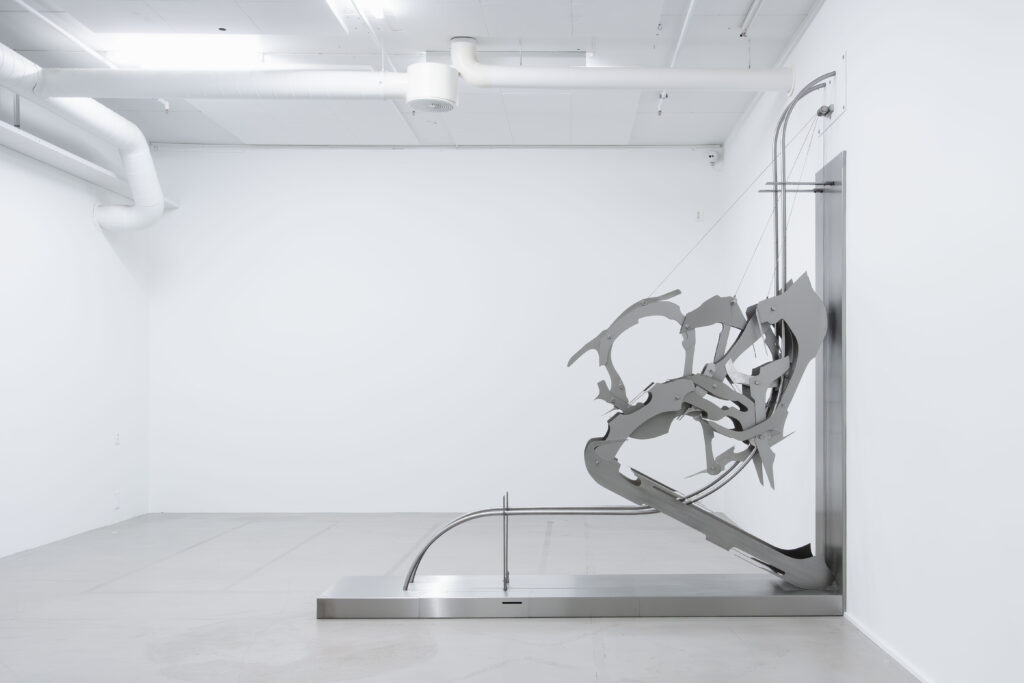
Joined by metal hardware and strung together like an instrument, the wires holding the pieces together increase and decrease in tension. As tension builds, the sculptures ascend, lifting off their platforms toward the ceiling. Reaching their apex, the wires release, gently lowering the structures until they kneel to the ground, succumbing to gravity. Every now and then, a sharp clang of metal on metal rings out as a sculpture drops. Yet all three stay fully intact, rising again to repeat their programmed dance. Watching them, were I able to come closer, I can imagine that the violence lying beneath these works might suddenly rise to the surface – a danger that is perhaps all too real within the confines of an art gallery.
The work necessitates patience, waiting for arrival and safe landing. It is reminiscent of puppetry, where the strings that activate a character are the same ones that release it into inaction. These steel forms are bodies under the control of an external force, stripped of autonomy and subjected to the artist’s programming. In this way, the artist acts as a governing force making decisions for bodies not her own.
Here, the body is a machine ordered to perform its choreographed duties: to dance, to be on display. It is not a far stretch from the demands that society and governments enact on constituents, particularly on women and people assigned female at birth. The exhibition’s title, The Barren, sharpens these tensions: Is the body solely a reproductive machine, and if so, what about those of us whose bodies cannot or simply do not wish to perform reproduction? As the exhibition text notes, «barren» is a term projected onto both women’s bodies and the land itself. A barren land is unable to produce fruit or sustain life, and therefore, in the eyes of extractive systems, unable to be profited from.
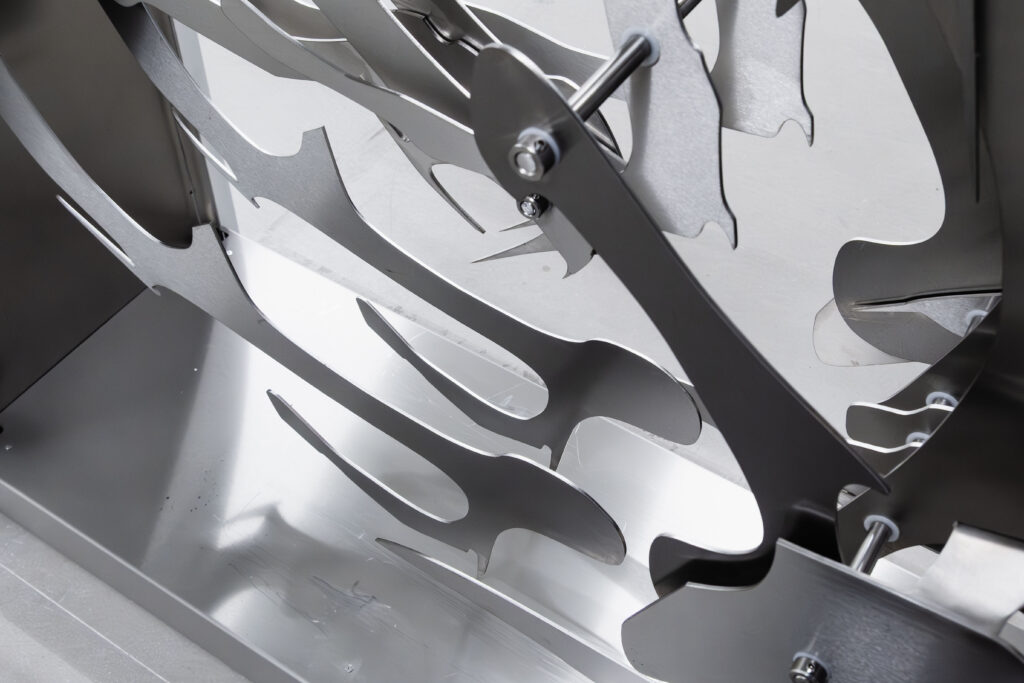
In the back room, I sit and wait, watching the full choreography of one of the three sculptures as it rises and falls. The soundscape pauses, takes a breath, and begins again, signaling a new cycle. By programming these industrial steel forms to lift, strain, collapse, and repeat, Andriessen points towards the exhausting demands placed upon bodies under control – whether it is the land being stripped of resources or individuals being expected to constantly produce and perform. The exhibition frames “barrenness” not necessarily as a deficiency, but as a space outside the grasp of exploitative reign – a space where there is great power in one’s refusal to produce, and where this refusal becomes an act of resilience.
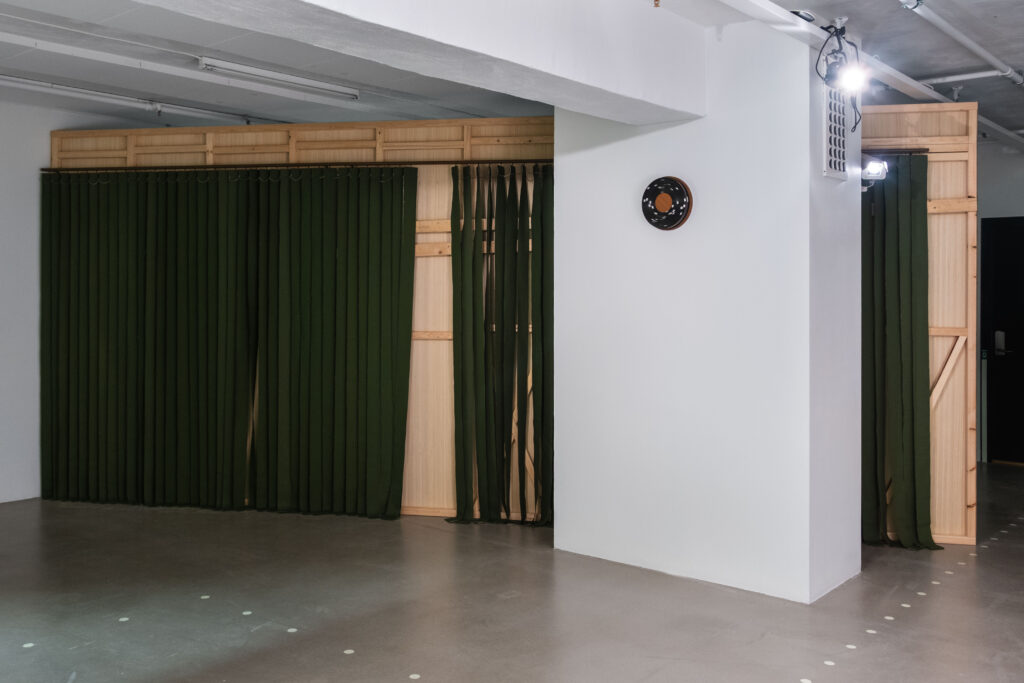
From the bright, light-filled upstairs galleries, stepping downstairs into near-total darkness reveals …in statues, still image, a solo exhibition by Swedish artist Mariella Otto. The exhibition gravitates toward corners – those oftentimes neglected, in-between architectural spaces. Wrapping around a corner at the bottom of the stairs is a sculptural work that mimics the form of window blinds: a white metal railing with hanging canvas blinds curves along both walls toward the floor, the fabric splaying out on either side like a creature in waiting. Upon closer inspection, these blinds are constructed from raw canvas, glasses-style brass chains, and paperclips. Otto borrows from the material language of the archive and administrative office, repurposing paperclips once meant to hold documents together to build these architectural structures.
To the left, a bright spotlight casts a harsh beam onto a circular wooden piece reminiscent of a chair cushion. Rather than a standard gallery fixture, this spotlight emanates from an altered CCTV camera mounted near the wall text. Outside on Kunsthall Trondheim’s facade, three similarly modified cameras shine spotlights onto random areas of the building. Motion-activated and stripped of their recording functions, these cameras instead highlight an emptiness that demands to be witnessed. In one area, a loose ceiling tile and plastic sheeting hang down beside a mounted camera, mimicking the aesthetics of a construction site and signaling a deliberate unfinishedness of the space.
Moving further into the gallery, my eyes adjust to the darkness required for the two video projections. The first video, which shares the exhibition’s title, blends archival footage with clips presumably captured by the artist herself. Entering midway through the loop, I am greeted by an ever-changing geographical coordinate in the corner of the screen, perhaps marking either where the footage is stored or the locations that are depicted. We watch the laborious process of digitizing film archives, a nesting-doll scenario of watching video footage capture the very process of digital preservation. A voiceover reflects on archival practices, noting that digitization is not merely a form of preservation, but a tool to increase access to these materials. The work creates a visual and sonic layering of technology, probing how digital tools shape what we preserve and how those archives are housed. Yet, even as these coordinates shift and the layers build throughout the video, the exact focus of this documentation remains slippery: what are we really looking at and what is being archived here?
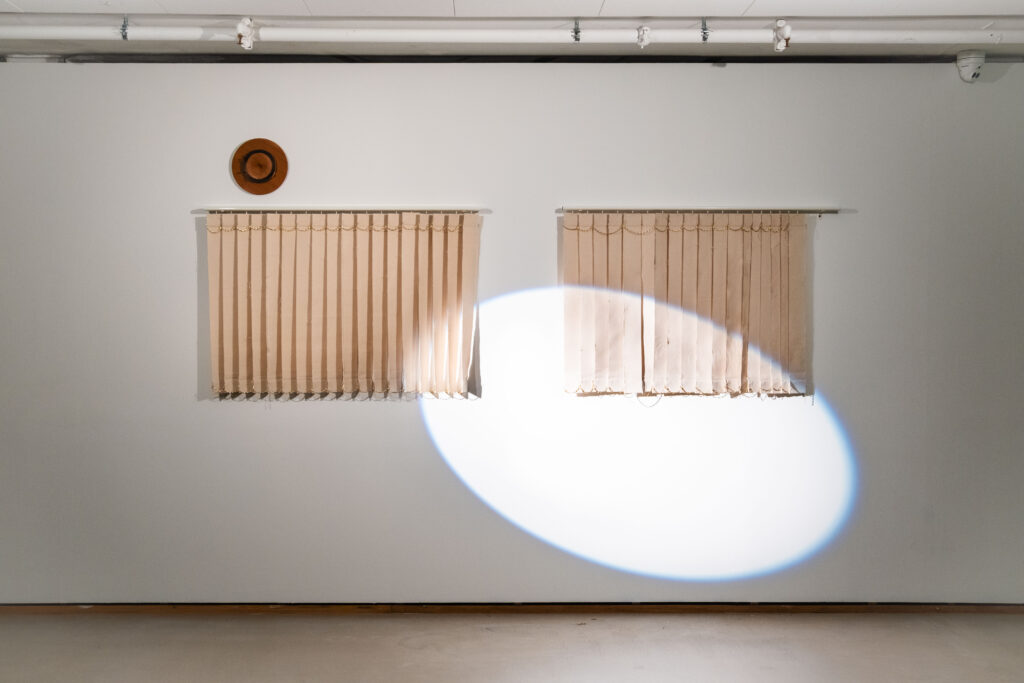
An installation on the adjacent wall is partially illuminated by an oblong oval spotlight from another modified CCTV camera. It targets the lower-right corner of a set of window blinds, above which a dull, moon-like wooden disc sits near the top left window. From a distance, this installation reads like a painting: compositionally balanced, it activates negative space and draws the viewer’s eye toward an intentional emptiness, echoing the surveillance spotlights outside. The wooden circle holds a 16mm film leader, the blank strip that usually bookends recorded footage. Titled Clocks (above main picture), these wooden pieces evoke the archiving of time: a method of capturing the present so it can be retrieved in the future. In a clock placed diagonally from the installation, a film leader winds around a central form, dotted with small white tabs like bookmarks. A film leader is designed solely to protect the footage that is yet to be projected. Stripped of its original purpose, however, the blank film strip protects nothing at all and becomes a material artifact of archival processes. This act of preservation through nothingness mirrors the CCTV spotlights, suggesting that meaning and presence often reside in what is blank, unrecorded, or unseen.
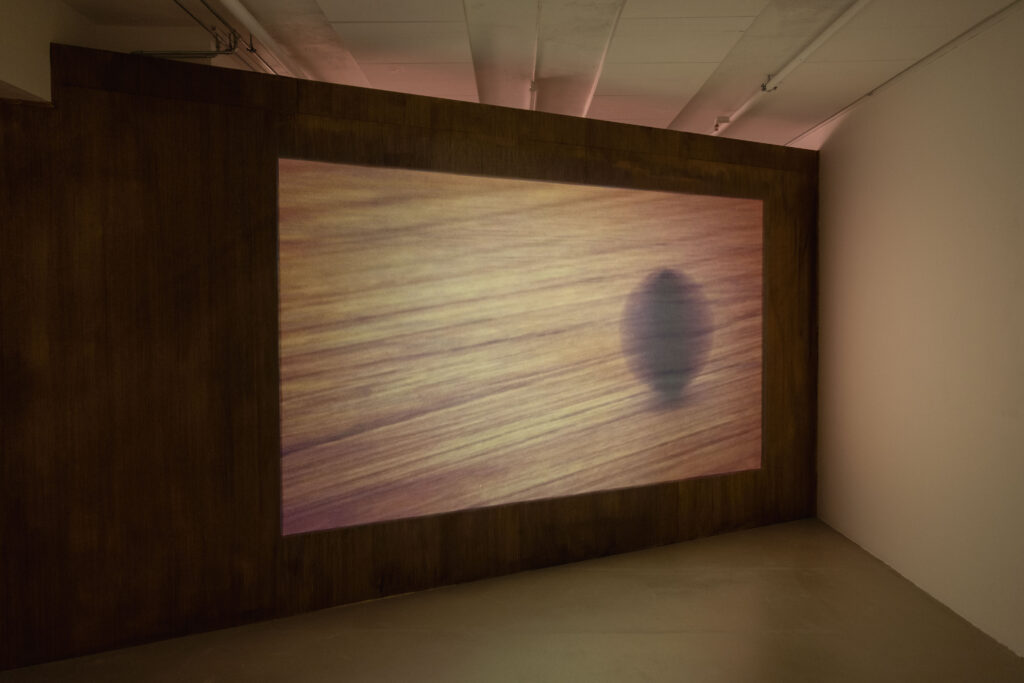
Toward the back of the gallery, a loop shows a coin endlessly spinning on a wooden table. Here lies a subtle conceptual echo of Isabelle Andriessen’s kinetic sculptures upstairs: the coin spins, falls, springs back up, and continues its dance. Framed in tight close-up, the setting is obscured, leaving only the hypnotic motion across the rectangle, resembling the rapid eye movements of REM sleep. Though it’s just one minute and forty-two seconds long, the video commands a much longer stay.
At face value, the exhibition investigates the mechanics and technologies of archiving, questioning and drawing attention to what society deems worthy of safekeeping. Otto plays with the material possibilities of spaces and systems that are typically hidden from view. There is a delicate tension here between the archive, a tool of protection and documentation, and surveillance. While standard CCTV cameras protect property by keeping watch, Otto’s modifications neutralize their function as recording witnesses, shifting the burden of observation onto the viewer.
While the work stems from a residency in Portugal, the specific histories, landscapes, and people of that region remain largely absent from the visual narrative. This absence makes it somewhat unclear what exactly is being narrated or archived, raising a critical question: Can we examine the archive as a standalone subject without engaging its cultural and political context? Otto’s approach is a seemingly impersonal, structural investigation – a valid endeavor, particularly given how visual art itself functions as an archive. Yet I wonder if anchoring the work to the specific contexts mentioned in the exhibition text might have given the physical objects greater resonance. Additionally, while the material significance of the hand-made blinds is clear, their execution reads somewhat rudimentary. As objects, I’m not quite as drawn to them as I am to the clocks; the dull, untreated canvas and painted railings feel distinctly unpolished in comparison. Ultimately, however, these raw material choices reinforce a core truth of the exhibition: that everything in our built environment is merely found, altered, and witnessed, rather than newly created.
The Barren
Isabelle Andriessen
…in statues, still image
Mariella Otto
Kunsthall Trondheim
22. oktober 2026 – 07. februar 2027
Artikkelfoto: Isabelle Andriessen, The Barren, Kunsthall Trondheim. F: Evelina Elere / Kunsthall Trondheim. Courtesy the artist and Kunsthall Trondheim.