Lost in digital noise
Kritikk, Reviews, Eso Malflor 07.08.2026
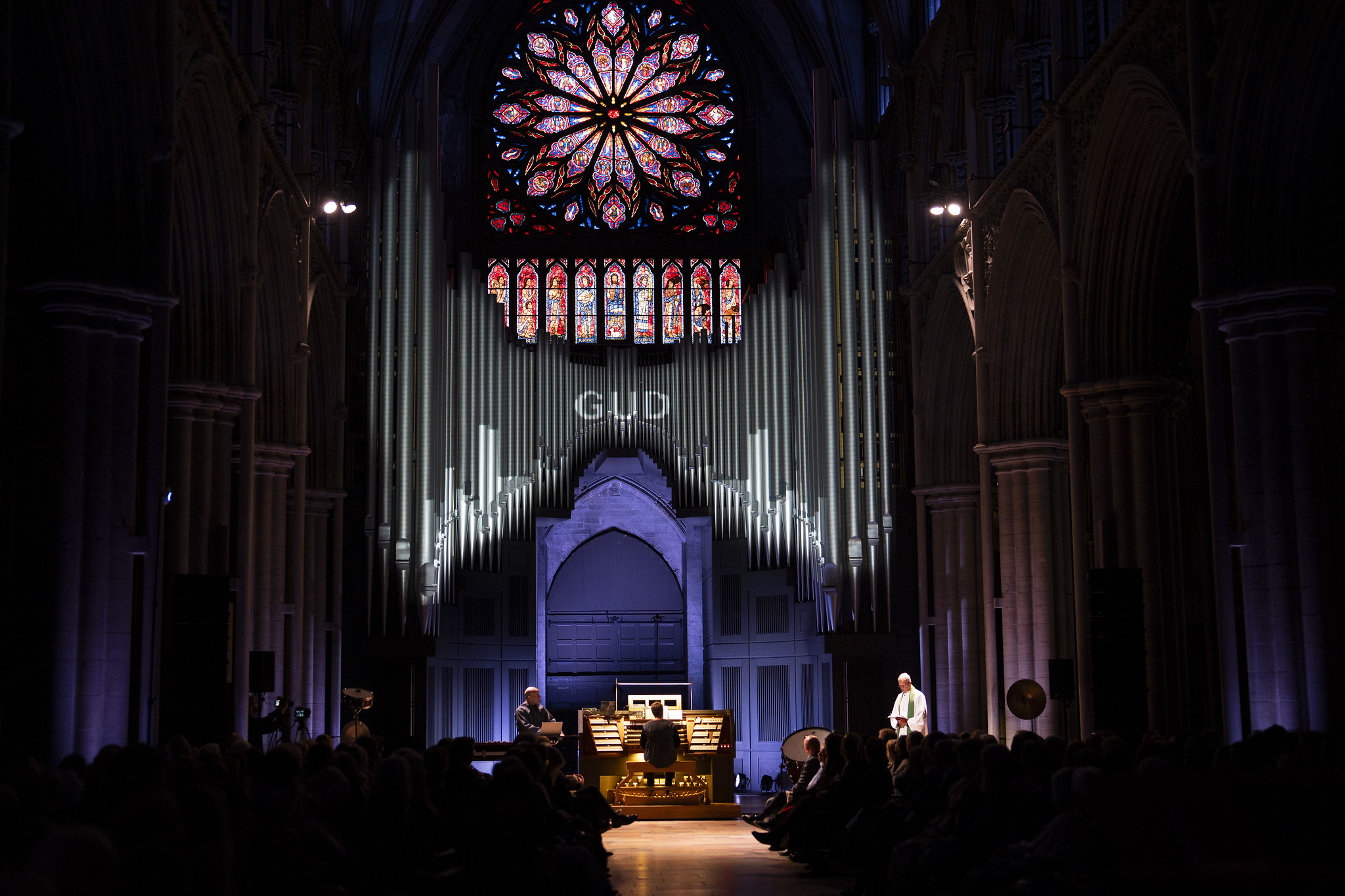
Kunstig intelligens i katedralen serves as both the closing event for Meta.Morf 2026 and the opening concert for Olavsfest 2026. Inside Nidarosdomen, an interdisciplinary group of artists led by composer Øyvind Brandtsegg, activates the cathedral’s majestic hall, using artificial intelligence to play the church’s organ pipes in an improvisational score. Olavsfest frames its program this year around the theme of “truth,” yet the performance offers little into what truth means when mediated by algorithmic logic. Instead, the piece remains a surface-level exploration, appearing as a disjointed spectacle that relies upon the sacred architecture of the cathedral to manufacture depth and spirituality.
Upon entering, audience members are handed a stone and invited to place it within a neatly formed square at the center of the cathedral. Inside, darkness is broken only by sunlight streaming through the rose window, casting red light onto the floor. Suddenly, without warning or a visible musician at the bench, music begins softly pouring out from the organ pipes.
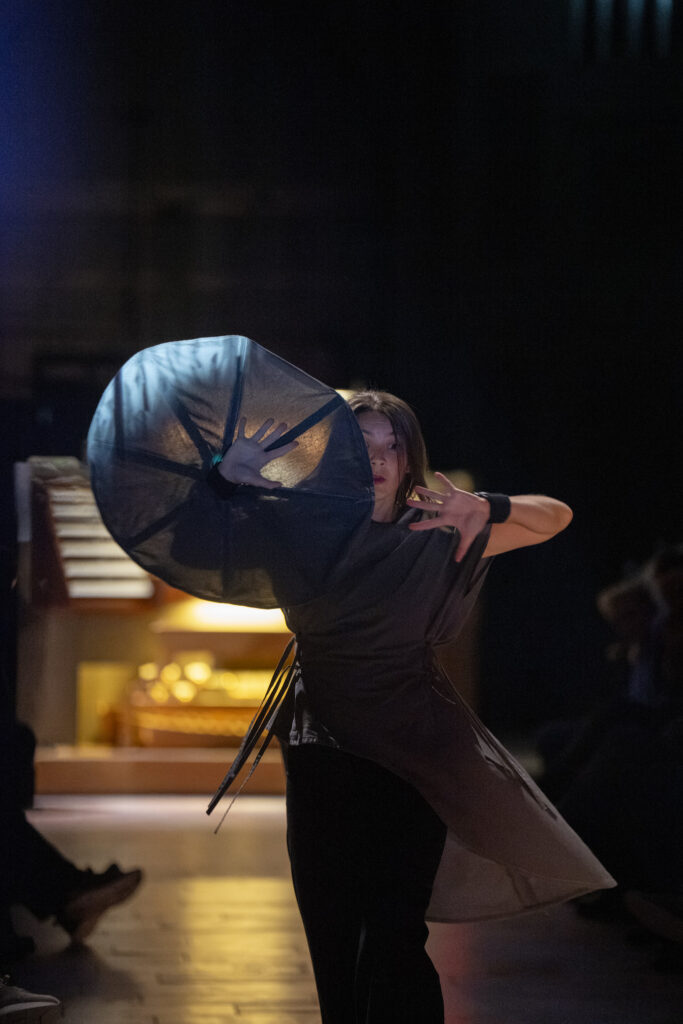
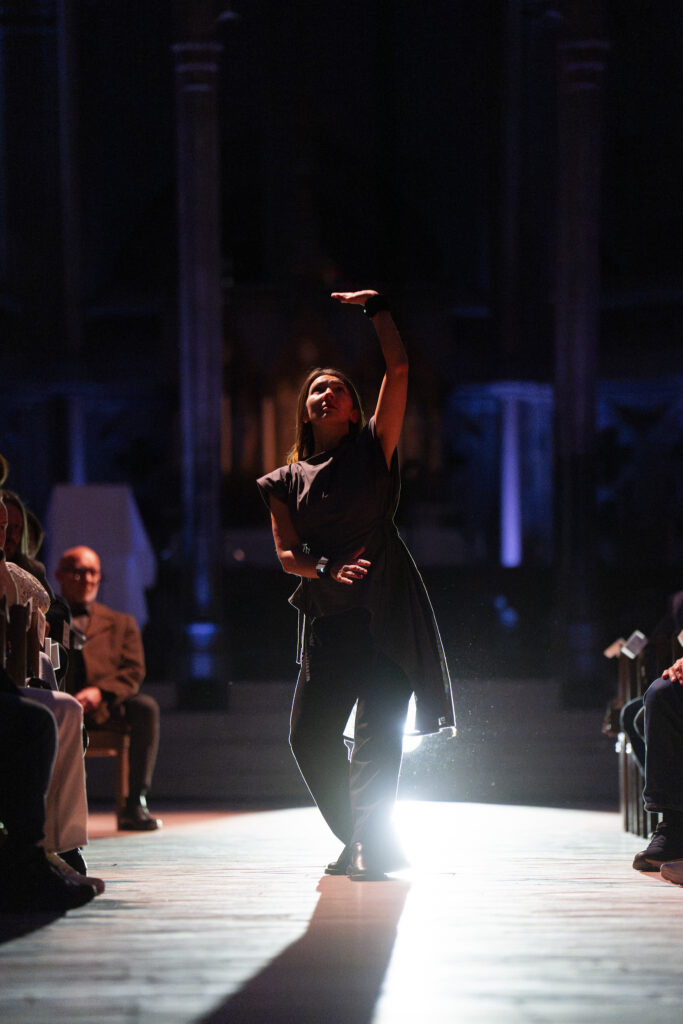
Soon, the organist Petra Bjørkhaug approaches, initiating a collaboration with the algorithmic output fed to the instrument. An airy, playful tune emerges, eventually descending into a dark, dramatic tone punctuated by erratic pauses. A dancer on the far side of the hall, Anna Thu Schmidt, begins to trigger vocalizing sounds via motion sensors strapped to her wrists. Even from a distance, the green lights of these wristbands remain glaringly visible; the performance makes no attempt to hide its technological apparatus. As the dancer reaches toward the towering arches, the sound crystallizes, her movements dictating pitch and flow. When her body freezes, the vocalizations abruptly cease. Moving toward the organ, she seems to battle or commune with an invisible force, her physical gestures all the while shaping the digital audio.
As the dancer recedes into the shadows near the organ, a «street priest» – as identified in the event’s programming – appears in white robes and a green stole. He begins a church service, his voice heavily distorted by audio processing routed through the organ’s system – as if he is speaking through the instrument, or perhaps the instrument through him. Subtitles projected onto the organ pipes display his sermon on truth, humanity, and love, invoking the biblical origin “In the beginning was the Word.” Here, the performance touches on a compelling thematic loop – recalling God’s creation of humanity, now mirrored in humanity’s creation of artificial intelligence.
Here, the artists play with the structure of the church sermon. Yet, with each new element introduced, the performance feels less like a cohesive work and more like a series of disconnected acts. The boundaries between human agency and machine autonomy also become more opaque. The musician returns to the organ but the audience’s seating arrangement hides her hands from view; no matter where one sits, it is impossible to witness everything occurring throughout this performance.
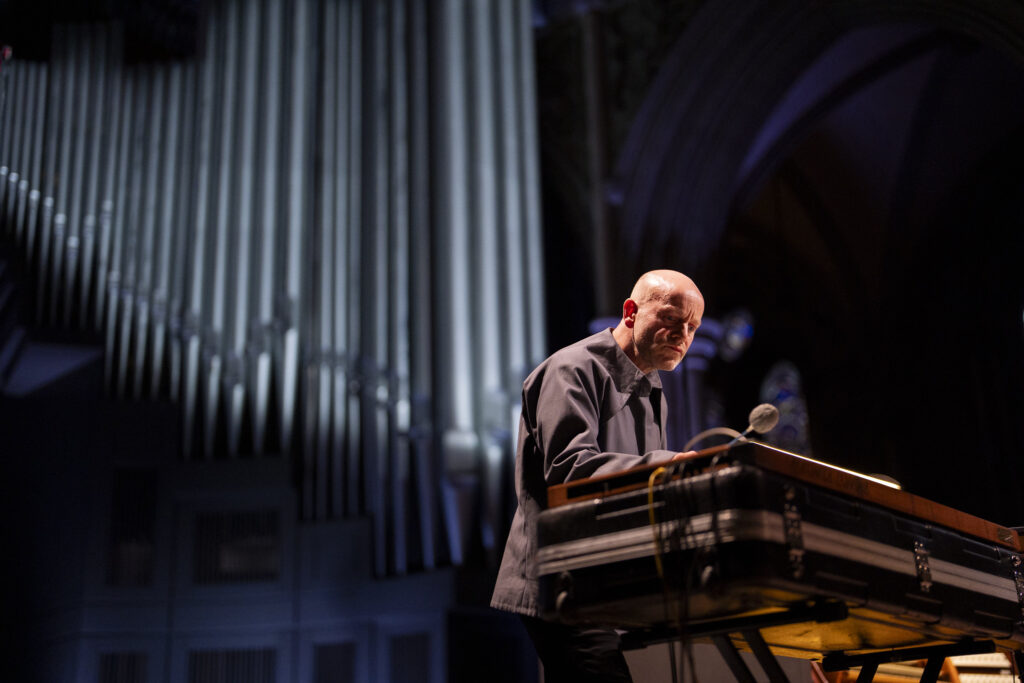
Percussive elements and a xylophone eventually join the mix, the sonic tone oscillating wildly between light, playful motifs and dark, droning bass – a dramatic, apocalyptic noise. For those without formal musical training, calling this soundscape «music» may feel generous. It neither pleases the ear nor invites contemplation. Despite my efforts to remain present and open, the overwhelming impression is that of an indiscriminate garbage disposal of instrumental noise, exacerbated by disjointed transitions between music, spoken word, and movement.
The dancer returns, traversing the floor from the organ back toward her point of origin. Projections on the organ pipes shift from text to abstract graphics resembling insects crawling across the vertical pipes. Now equipped with an expanded wrist device, her upward gestures unfurl like an umbrella or a shield. Here, the performance leans fully into pure electronic timbre, posing an implicit question: Is the human mimicking the machine, or is the machine mimicking the human?
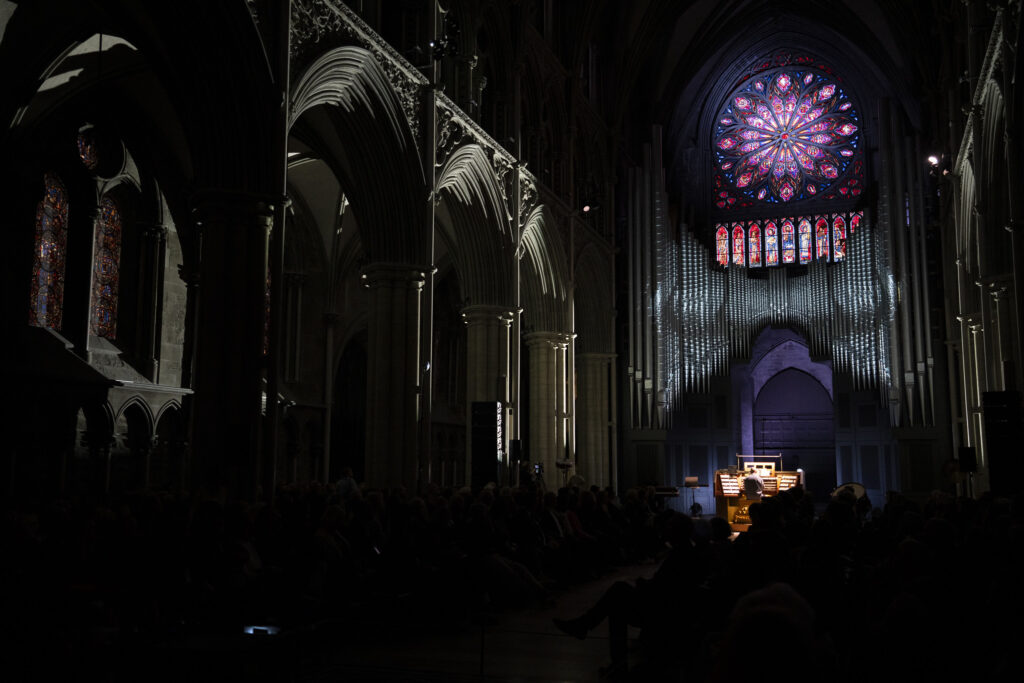
Finally, the rose window behind the organ springs to life with projection-mapped imagery resembling amoebic bacteria consuming the surrounding stone. Below the arch, a projected video showing hands placing stones echoes the participatory ritual encountered at the entrance. The sound of tumbling rocks merges with the xylophone in a call-and-response pattern; as the musician strikes a bar, the dancer drops a stone into the pile with nearly identical rhythm. Visual projections glitch along the pipes, distorting the cathedral’s architecture. The organ erupts into an entirely AI-driven sequence – a dark, rumbling crescendo that reaches a chaotic, deafening peak before dissolving into the ringing of church bells. The organist returns to offer a soft, folksy respite, bringing the evening to a gentle close.
One might consider whether Kunstig intelligens i katedralen’s spatial and conceptual jumbledness was intentional. If we grant the performance the benefit of the doubt, the opacity around what is human and what is artificial could be read as a mirror to our contemporary relationship with «truth.» In a global climate where truth is increasingly weaponized and we are becoming inundated with more and more generative AI content, deciphering reality from illusion has become an unsettling daily task. Perhaps the performance’s deliberate shielding of sightlines and ambiguous authorship was meant to reflect this cultural vertigo.
However, an assessment that feels closer to the truth is that the work remains surface-level, appearing less like a rigorous conceptual investigation and more like a slapped-together collage of themes and media. While the dancer’s movements projected a spiritual or existential yearning and the priest’s readings of scripture explicitly referenced faith, these elements never fully synthesized. Despite these inclusions, the piece surprisingly lacked any palpable sense of genuine transcendence; rather than building an authentic spiritual resonance through the performance itself, the work relied disproportionally upon the sacred architecture to do the heavy lifting.
This absence feels especially stark given the setting. Nidarosdomen is an architectural marvel built and restored through centuries of physical labor, sacred intention, and the historical intertwining of art and spiritual practice. The performance ultimately failed to consider the weight and acoustic nuance of this space, relying on chaotic volume over spatial sensitivity. Rather than evoking a dynamic spectrum of human emotion – hope, awe, dismay, or spiritual disturbance – the compositionally disjointed work left an unfortunate lingering void. By burying human artistry beneath an unrefined wall of digital noise and fragmented vignettes, the performance missed the opportunity to offer genuine introspection. Instead of a sacred dialogue between human and machine, we were left with a chaotic spectacle that struggled to justify its own ambition, leaving this viewer, at least, in an unexpected state of apathy.
Kunstig intelligens i katedralen
Olavsfest 2026 / Meta.Morf 2026
Nidarosdomen
28. juli 2026
Artikkelfoto: Kunstig intelligens i katedralen, Nidarosdomen, Olavsfest 2026/Meta.Morf 2026. F: Ole Martin Wold/Olavsfest