Queering the leikarring
Kritikk, Reviews, Eso Malflor 03.06.2026
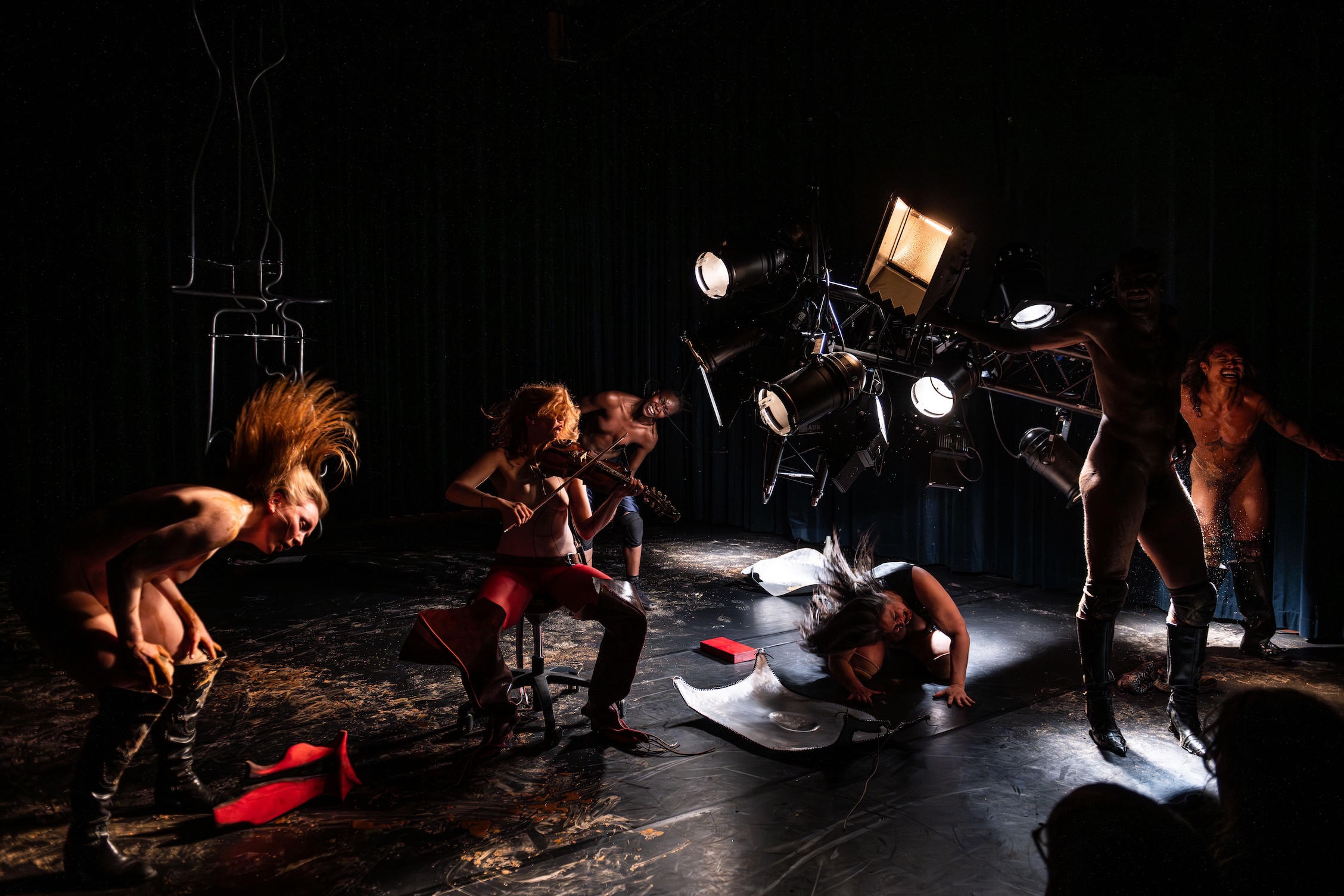
Sweet Spot by Harald Beharie is a performance that draws from Nordic folklore, queering and distorting the familiar and the traditional through sound, movement, and, most of all, play. Throughout the piece, the performers operate as individual actors who coalesce at times and splinter at others, constantly oscillating between the singular self and the communal whole. Upon entering the theater, the audience is met with an installation waiting for activation: cowbells dangle from long strings, a conglomerate of stage lights hangs low to the ground, and a slowly rotating sculpture of curved, twisting metal foreshadows the choreography to come.
One by one, the performers slip onto the stage through black curtains from various entry points. The first is Beharie, entirely nude except for a pair of tall black leather boots with metal accoutrements that transform each stomp and sway into a percussive instrument. Mouths agape, the performers emit a breathless, throat-croaking sound akin to a laughing gull, immediately drawing attention to their presence. In this first scene, their jaws never close; they begin to drool – on themselves and each other – as they slowly gravitate towards each other to interact. There is a deliberate, calculated discomfort here: the locked-jaw smiles, the ecstatic laughing, and the exposure of one’s naked asshole to the front row of the audience from less than half a meter away.
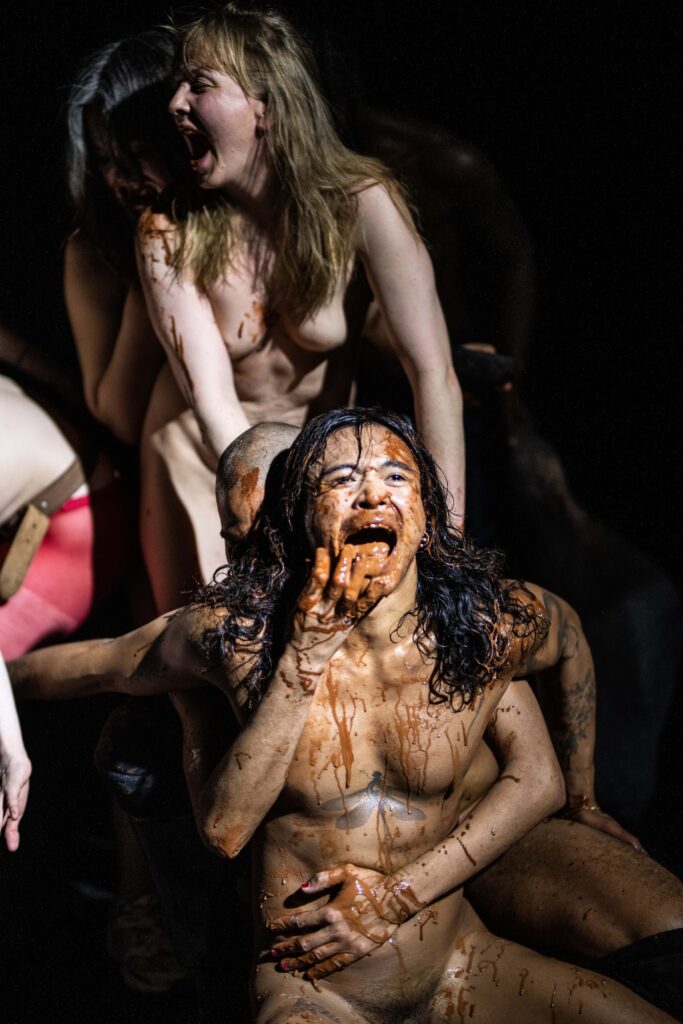
Moving toward the hanging light structure, the performers’ bodies assemble into a kind of distorted family portrait. They continue to laugh, mouths still open, as they climb atop and hold one another, their breathless chuckling gaining volume as they lift and support each other’s weight. Elevated onto the shoulders of another, one performer reaches for a bowl atop the rotating metal sculpture. A force-feeding frenzy ensues: a mixture of flour and water is smeared across flesh and faces. One performer drops to all fours as the raw, beige dough is shoved into their mouth, leading to audible choking. The scene is sickly sexual, treading a razor-thin line between care and consensual abuse. Just as the audience is trapped, forced to witness this somatic struggle, the performers act as mirrors to our collective paralysis.
Suddenly, a hummed melody instrumentalizes the entire stage. The performers step and stomp in rhythm, thighs and skin slapping together. A new character enters, walking backward toward center stage in red fishnet stockings and boots, a Hardanger fiddle in hand. As she plays, each performer takes a turn stepping into the spotlight to dance and writhe. The fiddler, seated upon a rolling stool, is swept toward the light structure on the right. At some point, she stops playing. They are all dancing in unison now, their separate expressions dissolved into a singular composition. The stage floor itself becomes a drum, just as every object in the room is transformed into an apparatus of sound. One performer stomps on the stairs, sending the vibration directly through our chairs. In this way, the separation of stage from the audience becomes blurred. While the setup of Rosendal Teater enforces a rigid separation via tiered seating, Beharie’s performers refuse to abide by these lines. This spatial violation functions as an invitation into the leikarring; by dragging us into the loop, Beharie implicates the audience not merely as passive observers, but as active enactors of modern cultural attitudes and potential participants of the play ring. Though the choreography would arguably achieve its ultimate goal by being in-the-round – where the audience would form a literal circle and continuous ring – this cross-boundary involvement is a successful strategy as opposed to a safe, distant, and detached viewing experience. It strips the audience of its protective anonymity, demanding that we step outside of our isolated positions and into a site of raw, collective presence.
As a group, the performers begin to skip, circling the stage floor counter-clockwise. They hold hands, stretch their arms wide, and embrace while moving in lockstep. This circling formation reads as a subverted play ring – a distortion that collapses the wholesome, nationalistic tradition of the Scandinavian leikarring directly into the transgressive, carnal space of a queer play party. Folk dance and sexual play merge into the same collective loop. While the preservation of folk culture tends to flatten these dances into static instruments of historical preservation and family-friendly entertainment, its historical roots were far more suggestive, ecstatic, and occasionally magical. By tapping into these primal undertones, Beharie isn’t merely parodying, but is staging a radical reclamation.
Much like traditional folk forms historically functioned to construct and reinforce a localized communal identity, Sweet Spot utilizes its structure to map out a collective queer lineage. This play ring does not just showcase the polished, celebratory facets of community, but exposes the complicated, messy struggles of intimacy – the vulnerability of baring oneself entirely within the group. To queer the folk dance here is not to discard it, but to work both with and against its modern domesticity – shifting the ritual back to its original state of living, breathing, animalistic agency.
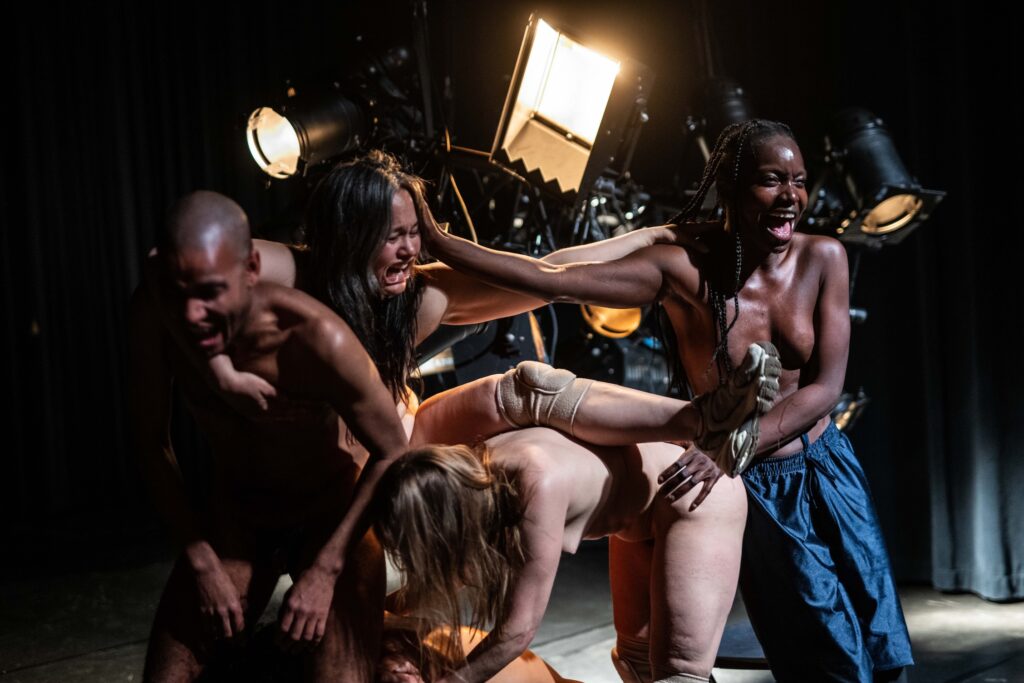
The fiddler plays again as the lights dim into near-total darkness, and the performers take turns dancing in the spotlight – twirling, spinning, and skipping. Mid-movement, the person seated next to me hands me a stack of freshly made waffles to pass down the row. Served without a plate, we pass this warm food directly from one stranger’s hand to another’s. Taking a slice, I pause, momentarily unsure if I should eat it, before giving in to the strange intimacy of sharing a meal (and bacteria) in the dark.
Then we enter a total blackout, save for tea lights illuminating three corners of the floor. The fiddler vocalizes alongside her instrument while Beharie spins endlessly in the center. I find myself holding my breath, thinking of the sheer dizziness of sustaining such a whirlwind of force, but also of the profound freedom that endless spinning connotes. This is not a decorative or meditative ritual; it is an incredible, exhausting physical feat of sheer athleticism, akin to the relentless momentum of a figure skater. It is a testament to Beharie’s rigorous physical endurance, a seemingly never-ending whirlwind of force that leaves the room suspended in tension.
But then, the momentum breaks. The skepticism of the room is palpable just as the applause breaks out and the performers bow. Yet, from beginning to end, we are kept on a threshold, unsure of what is beginning or what is ceasing to happen. Fittingly, the skipping resumes, the waffles continue to circulate, and the fiddler strikes a single note. The performers harmonize, vocalizing against one person’s breathless screech, and suddenly we are looped back to the very start: mouths hanging wide, tongues dangling, bodies writhing, and shins rhythmically slamming against the floor.
The profound trust, care, and connection between the performers is undeniable. Sweet Spot is steeped in play, pleasure, desire, and unapologetic queerness. However, it is less of a showcase of queer identity than it is a demonstration of queering as a verb – an active process of taking what one is given and making it one’s own, all the while completely subverting expectations. It acts as a necessary puncture into the lingering stiffness of contemporary public life. In a culture where social interactions often can feel polite but closed-off, the performance lands as a direct confrontation with collective conditioning.
The animalistic components of existence that we are expected to compartmentalize – the friction of being a body governed by base desires – are fully exposed here. What joy may we find if we only let ourselves dance, writhe, shake, drool, and cackle? By dragging what is usually privatized within the mind or the bedroom onto a literal stage, Beharie invites a communal reckoning with our own biology. The audience is encouraged to consume nude bodies, unvarnished tradition, and warm waffles all at once, proving that these somatic exchanges are not just purely entertainment, but the very infrastructure required to sustain a community.
All photos: Bart Grietens
Harald Beharie
Sweet Spot, 27. mai 2026
Rosendal Teater