Agency in the Era of Automation

Kritikk, Reviews, Eso Malflor 21.04.2026
The exhibition Future Manifestos at Kjøpmannsgata Ung Kunst (K.U.K.) serves as the central hub for Meta.Morf 2026, the Biennale for Art and Technology in Trondheim. Since its inception, Meta.Morf has functioned as a critical laboratory for the intersection of biotechnology, digital culture, and artistic research.
Future Manifestos gathers an array of international and local voices to interrogate our collective agency in an increasingly algorithmically dominated world. While the exhibition is conceptually cohesive, linked by a recurring sense of existential urgency, it is also a study in material divergence. The works range from the visceral and bodily to the cold, hollow simulations of «AI-born» artists, presenting friction between the tangible human hand and the detached logic of machines. It is a show that feels timely, not because it celebrates technological progress, but because it exposes the glitches and power structures embedded within, questioning the feasibility and quality of a future where creativity is outsourced to code.
In Hjørnegalleriet, I am met with an installation of five video works accompanied by large vinyl images and text. In capitalized blue letters, “THIS IS NOT ART!” hovers among images of famous artists – Warhol, Tanning, Beuys, Dalí, Friedrich, Miller, Koons, Duchamp – alongside text expressing each artist’s intentions and how AI essentially does the opposite. One of the installations, by Boris Eldagsen, begins with a black-and-white video moving through the ABC’s of human emotions: anxiety, boredom, calm, compassion. The pacing is deliberate; the text reads “ON (insert emotion)” before cutting to short, AI-generated clips of Joseph Beuys and a coyote, à la his performance I Like America and America Likes Me that took place in 1974. Here, AI’s ‘hand’ is exposed; in one clip, Beuys holds the coyote and then suddenly, its form shapeshifts as he lifts it, pulling his arms through to wear the animal as a coat. In certain scenes, the pixels rendering the AI-generated scenes are visible, exposing the code that created this work.

Another video depicts Charles Bukowski in a compilation of scenes, connected through a ghostly monologue, but visually, he appears in slightly different environments, the lighting and furniture shifting just enough to feel wrong. His rant argues for the necessity of «dirtiness» within human creation; AI is too clean, too ‘perfect.’ Even the ghost of Van Gogh appears, his hands covered in colorful paint that remains impossibly clean as he runs his fingers through his hair. Of his audience using AI to mimic him, he says: “They want the sunflowers without the decay, the sky without the insomnia.”
Resurrected through video, these predominantly white male artists serve as messengers for modern anxieties. However, since these views are already common among the living, a question remains: do we really need Van Gogh to warn us about a future that is already here? A break in this historical lineup occurs with a «punk» character in a city alley. While compelling, the punk doesn’t hold the same historical weight or authoritative positionality as Van Gogh. Punk holds power, but it is from the outskirts – outside the mainstream canons. Perhaps by placing this video within the installation, Eldagsen points to the importance of rebellion; we should be paying attention to punks as much as we pay attention to Beuys.
The most visceral video features an AI-generated Francis Bacon, who likens art to a ‘scream,’ noting that “to scream, you need a body.” While all the videos feature rage, this one is loud, sonically and visually. By utilizing AI to stage a rant against its own existence, the work creates a self-referential loop where the technology is both the medium and the messenger, leaving us with a parody that critiques the system all the while remaining entirely dependent on it. The installation is an ouroboros; like a self-consuming serpent the artist declares that “this is not art” while exhibiting it in a contemporary gallery, and so the opposing claims continue to shift and swirl in an eternal circle. As the didactic exhibition text notes, these works do not stand outside the system they critique, they operate from within it.

This position is familiar to those in the arts; the institution is a complex framework, creating standards by which we must live and exhibit but not always providing the resources for artists to actually survive. In the lobby, I encounter the work of Syver Lauritz. An oil painting of a reclining nude woman hangs next to three screens flashing AI images. The painting is classical in its treatment, blue drapery and sheets surround the figure, but her body consists of multiple limbs branching from the shoulders and a third breast on her bicep. The body is glitching, repeating forms that are sometimes connected and at others hovering in mid-air. The mistakes are clear and fully embraced. Lauritz holds these imperfections on the same pedestal as classical nudes, questioning the idealized human form by celebrating the «broken» anatomy that technology is used to smooth away.
However, one cannot ignore the irony of using the most traditional of power structures in art history – the male artist depicting a passive, nude woman – to critique a new technological one also informed by the male gaze. The work risks replicating the same values held by Silicon Valley tech bros: a world where the female form is merely data to be manipulated, distorted, consumed, or “perfected” by a distant male creator. It raises the question of whether artists using AI in this way are truly disrupting the canon or if they are simply dressing up old power dynamics in the glitchy aesthetic of new machinery.

Past the gift shop into Bunkersen is a large-scale installation by !Mediengruppe Bitnik with neon signs and bean bags. Red neon text on the wall reads “Doomscroll at work not in bed” and “Leave your phone.” The screens mimic TikTok feeds featuring Qwen Stefani, an AI counterpart to the real Gwen Stefani, who has, in real life, apparently become a conservative Catholic influencer. Qwen is a modern AI damsel in distress, tears of honey-like viscosity streaming down her face as she calmly advocates for «tech-sabotage.» She suggests we «tamper with metadata» to make our data less useful for bots. On the floor, a pile of silver foil wrappers with the words “simple sabotage cookie” sits, reflecting the neon. It recalls the candy installations of Felix Gonzalez-Torres, where the audience is invited to take a piece, although I’m unsure if I’m allowed to here. The cookie is a double-entendre, a physicalization of the digital cookies that track our every move. I wonder if taking one would actually support my journey against techfascism, or if it’s just another layer of humor.
Whereas Gonzalez-Torres’ installations held a literal and conceptual physical weight related to the imminent death prescribed to gay men in the 80s and 90s, these «sabotage cookies» feel performative. The installation pushes for revolution through buzzwords, yet fails to provide any actionable roadmap for the sabotage it advocates for. Ultimately, we are caught in another digital ouroboros: a machine warning us against the machine, utilizing the same addictive interfaces it claims to critique. Rather than an act of liberation, the work feels like an aesthetic loop, offering us just a taste of rebellion without the actual tools to dismantle the system.

In Bingohallen, multiple artists’ works interact. I see two AI-generated men discussing Universal Basic Income with the stilted rhythm of a chatbot: “what if our work, our purpose wasn’t about having a job at all?” Their lack of facial expression solidifies their existence as avatars. Nearby, a multimedia installation by Andy Gracie proposes architectural structures for a desolate landscape 200 million years from now. A large triangular monument stands near physical sand that seems to flow out of a projected desert. The sand is contained, suggesting this world is tied to this specific area, yet I find myself wanting the material to extend further. I want to be immersed in this future, to understand through my body the need for this architecture.
However, my willingness to suspend disbelief is broken by Yirrkala Dhunba’s Indigenous Genomic Adaptation. Abstract patterns recalling DNA sequencing sit in front of a video of the «artist» explaining her process. I feel suspicious immediately; the work feels incredibly flat. Dhunba, as it turns out, is not a human, but an AI-generated artist programmed to create work on “how Indigenous futures are dominated by the language of biotechnology.” This word-salad statement reaffirms the work’s baselessness. To the untrained eye, this might pass as a standard project, but to artists and many others, the bullshit is crystal clear.
Visually and technically, the work is uninteresting, though one could argue this cheapness is precisely the point. Here, it is proven that AI cannot replace artists – at least not yet. The flatness of the work serves as a commentary on the hollow, extractive nature of AI-generated identities, perhaps even offering a grim taste of how the art scene might look in a future where AI remains unregulated. I wonder if the inclusion of this non-existent «Indigenous» artist is meant to be a cautionary tale about the total erasure of the human hand and history. Yet, even if we are to accept this mediocrity as a deliberate conceptual warning, the ethical weight of the project remains questionable. In an exhibition with no living Indigenous artists, the decision to host a simulation feels like a precarious way to critique historical erasure, while actually appearing to replicate it instead. Whatever the curatorial justification, I am left doubting whether the lesson is worth the space it takes up, and if we are truly gaining insight or just witnessing a new form of digital erasure and displacement.

The show rounds out with Dani Ploeger’s Improvised Inflatable Device (Fat Man). When I dial a phone number on the wall, a silver fabric «bomb» inflates. It calls to mind the disgusting ease of pressing a button to send nuclear strikes to destroy innocent lives. Finally, Hege Tapio’s Trilogy of Transformations presents a manifesto of «metabolic futurism.» The vitrines hold liquids, black gold and biofuel, extracted from human waste and adipose tissue. A still life photograph shows raw meat on a table, skin intact, maintaining the color of a living (human) being. It is a chilling alternative to earthly extraction: if we continue to drill the seas dry, we may one day need to extract from ourselves to sustain industry.
As I leave, I pass three glitched portraits by another «AI-born» artist. They look like high school Photoshop experiments – technically and conceptually hollow. There is no hand in the work, no true purpose for its existence. It feels like fluff. AI as a tool has much to offer, but when AI becomes the creator, the result is generally uninteresting and bad. As stated in its exhibition text, Future Manifestos asks: “Who decides what remains human?” In the works of Tapio, Lauritz, and Gracie, technology is a resource used to inform human creation. But when the human creators take a back seat, when the names on the wall belong to algorithms, we should be wary.

Ultimately, Future Manifestos serves more as a warning than as an invitation. As a cautionary look into a future without regulation, the exhibition is deeply effective; it leaves the viewer with – or perhaps solidifies – an unease about the speed at which the human hand is being relegated to a secondary role. The manifestos proposed by the “AI-born” artists and simulated personas feel more like an echo chamber than a call to action – a machine warning us of its own inevitable rise. While these digital works are intellectually curious, they lack the visceral impact of those firmly based in our material reality. It is in the metabolic experiments of Hege Tapio’s biofuel or the architectural propositions of Andy Gracie that the exhibition finds its true power. These experientially-driven manifestos are far more inspiring, as they use technology to expand our understanding of the body and the earth rather than merely simulating their replacement. If Future Manifestos proves anything, it is that the most compelling visions of the future are not those generated by an algorithm, but those that insist on the irreplaceable agency of the creative human being.
Meta.Morf 2026 – Future Manifestos
K.U.K.
09. april – 31. mai 2026
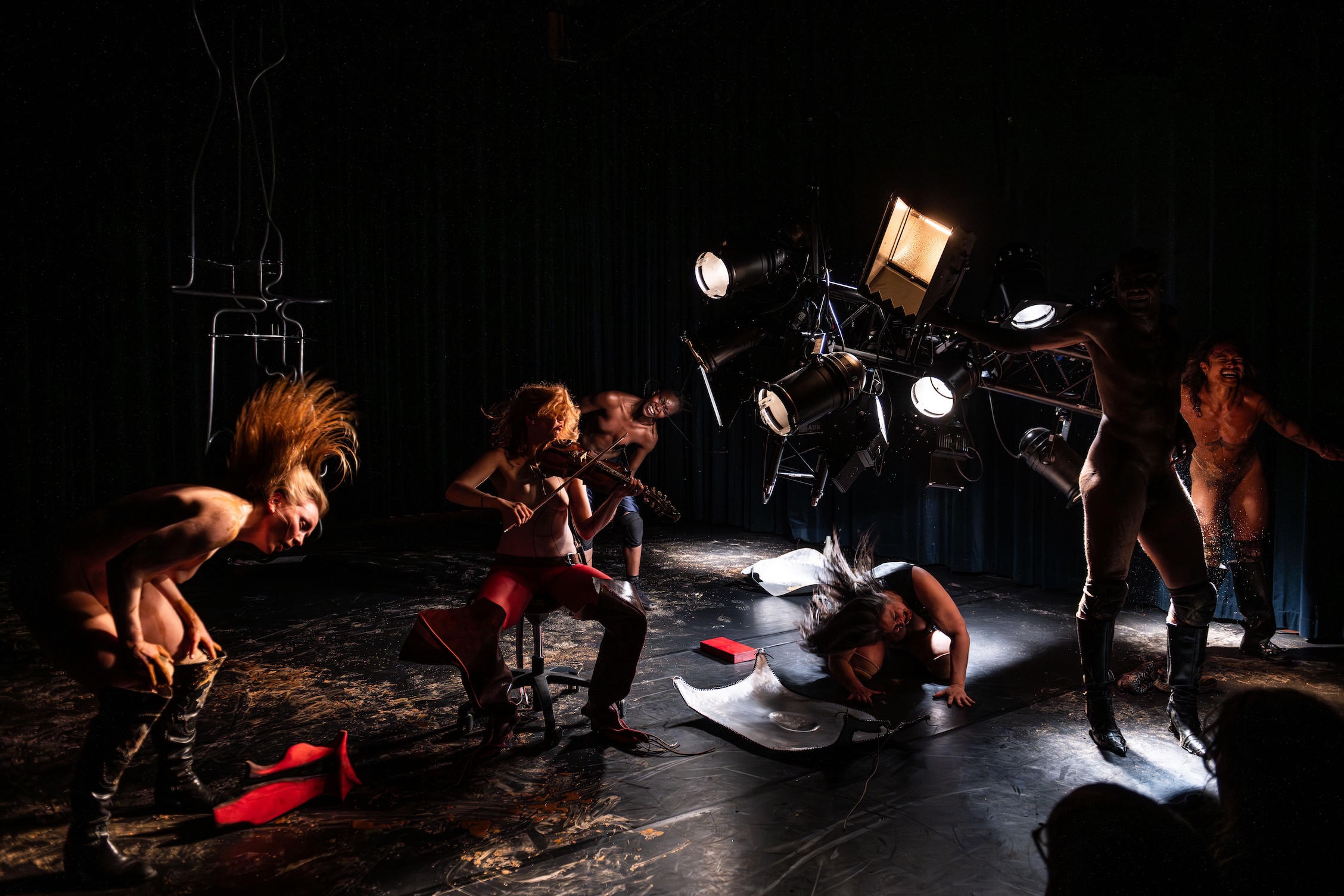
Artikkelfoto: Sputniko!, Tech Bro Debates Humanity, Meta.Morf 2026 – Future Manifestos. F: Juliane Schütz