Transposing Landscape – a conversation with Catherine Opie
Interviews, Intervju, Märit Aronsson-Towler 11.08.2026
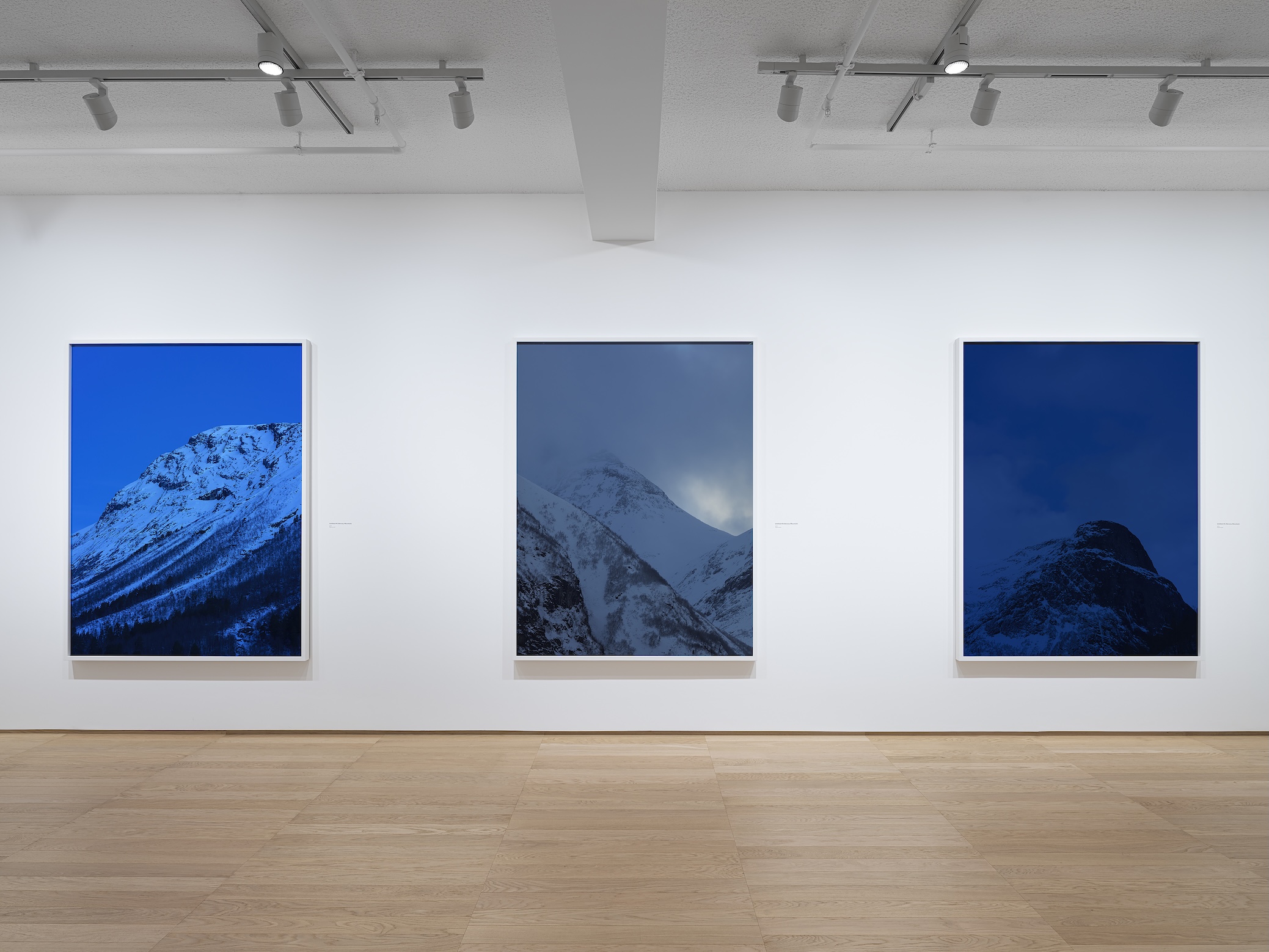
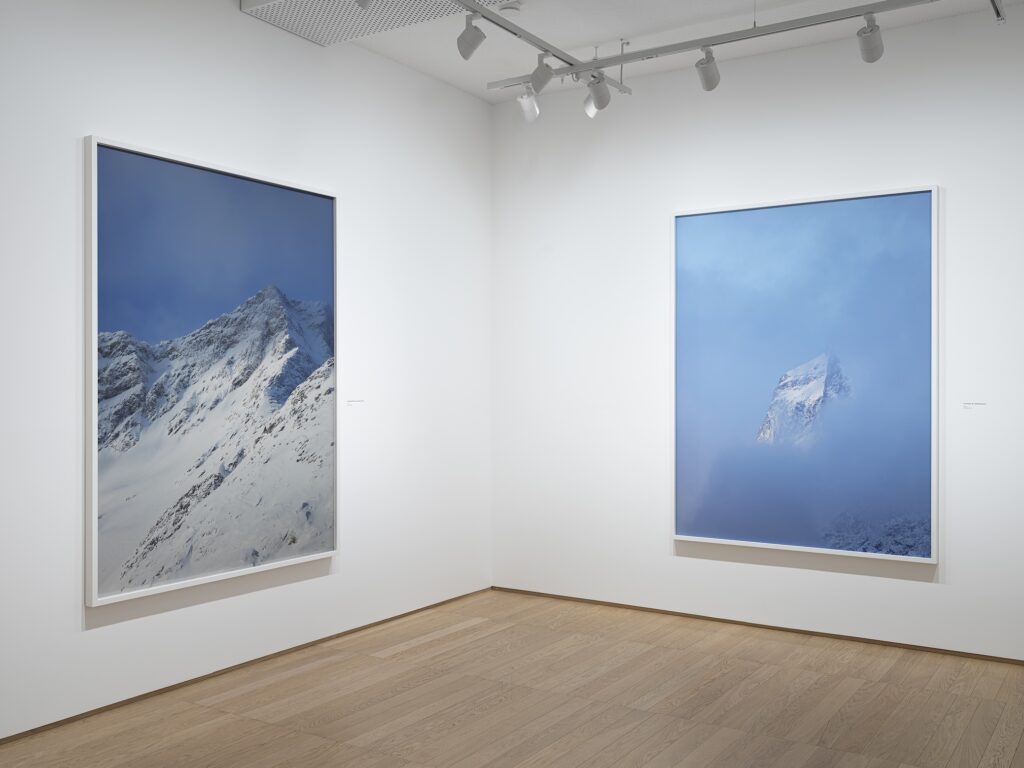
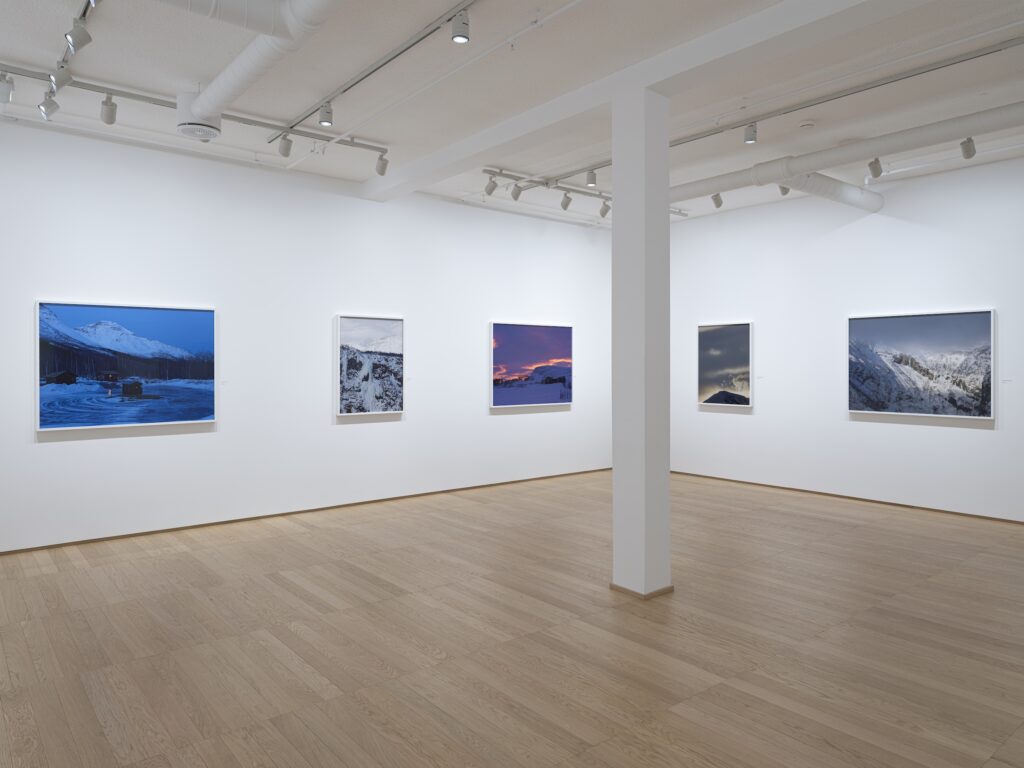
Catherine Opie was nine years old when she got her first camera, and has photographed ever since. The urge to change the world through photography has always been present in her wide ranging works. Questioning ideas of identity, norms and national symbols, her most famous works include pioneer portraits of friends in the Los Angeles queer community in the 90’s and onwards. Visiting Norway for the first time fifteen years ago, she was introduced with Harald Sohlbergs Vinternatt i Rondane, and the idea of exploring the Norwegian mountains was born. Now, her show The Mountains Don’t Know Their Names is tailor made for the rooms in Pomo’s second floor in Trondheim. We sat down for a conversation about the blue of distance, the unconscious and if her images might change the way we look at mountains.
Märit: Preparing for this interview, digging into the substance of the exhibition, the word distance became very prominent, both physically and metaphorically. You come from far away, and the colour blue is all about distance. Let’s start with your approach to the Norwegian mountains. How does the fact that you come from the other side of the world affect your gaze?
Catherine: Firstly, it comes with thinking; ’who am I to go to Norway to make a body of work when it’s not my landscape?’ That’s the immediate question in terms of trying to reach something with more depth and not just as a tourist. It started with the urge to find the blue in the landscape and see if I’m able to capture it. I had no idea if it would work, if the physicality of the scale of the prints would work or if the image would hold up. There is an enormous amount of failure in photography, actually. And also, I didn’t know if it would be too much of a cliché. In the same way people feel about representations of the other, I thought, ‘am I going to fail’?
M: Yes, there’s a risk that it becomes a cliché when you take on such well represented motifs.
C: That’s why I started out with the Cliché Room. I then acknowledge that this visual language exists within landscape photography. You mentioned distance as a metaphorical concept, which is interesting because that is actually how we act within nature as a species. It begins and ends with philosophical questions, on whether a body of work can have more complicated conversations that go beyond the cliché. That’s what I would hope for, but I didn’t know if I would succeed. I do find the show successful, and I find it moving, and I hope it is for everybody who sees it, that they all feel the same kind of energy and spirit that I brought to this. It’s about us deciding to no longer create the notion of the other. Is it time for us, as a world, as a species, with all the knowledge that we have, to reconsider why we are repeating the same pattern over and over again? Why aren’t we more aware of how we treat the environment? So the blue is mourning, too.
That’s the other kind of distance I was thinking of. The distance in loss and longing. I know that one of your favourite books is Rebecca Solnit’s A Field Guide to Getting Lost. That is in fact one of my favourites, too! Every second chapter has the title The Blue of Distance.
Yes, that book especially, and also Eileen Myles’ The Importance of Being Iceland have held this kind of place of representation and ideas of how I can transpose the landscape, so to speak. When can a landscape be other things, philosophically, to us?
Rebecca Solnit writes about blue as the colour of melancholy: Blue is the colour of longing for the distances you never arrive in. But you don’t strike me as a very melancholic person?
No, I’m not melancholic, I’m incredibly optimistic. I think that I’ve had moments of depression, and I had a very intense childhood that probably would leave most people pretty messed up. It certainly has affected me, but I always have believed in the better part of everybody. I have faced hate, I have faced death threats, and I’m still willing to think that we’re all going to end up figuring it out, somehow.
That’s good to hear!
But it doesn’t look very good right now!
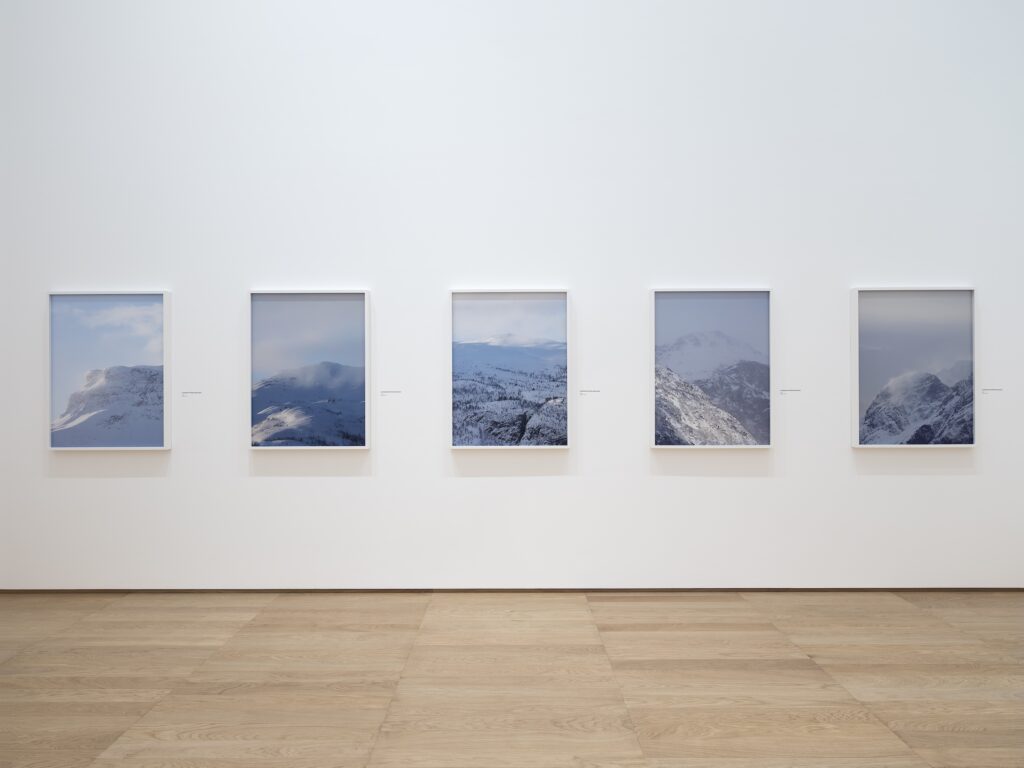
The title of the show; Mountains Don’t Know Their Names makes one think of the human impulse to conquer and tame the land. It also makes me think of the unknown, the Terra Incognita and the subconscious within ourselves. Is that something you are interested in?
We have to name everything. But we don’t just name. We own. I’m interested in the subconscious. I’m interested in the idea of the void and things that emerge. I think my mountains emerge from the frame, in a certain way. The physicality of the print and the positioning of the lens to the descripting, whether it’s coming up from low or you don’t know where the mountain meets sky, because it fades out. That is another analogy of our subconscious, to a certain extent. It’s that feeling when you know a place and then you don’t know it. I mean, we go around in our lives and we have visual cues, or landmarks, so that we can have a sense of attachment, a sense of nostalgia. For instance when I go home to Sandusky, Ohio, even though I left when I was 13, I don’t need a map to get around my home town. I have the memory of a child before I even drove a car, of knowing exactly where to get to, and of how I wandered or went on my bike or in the car with my parents. Since we didn’t have devices, we looked out the window, so we had landmarks. It’s the same thing with these mountains, the mountains don’t know their names and I’m not telling you where I geographically went. But at the same time, there will be people watching the show that will say ‘I know that mountain!’ And that’s really cool. That means it’s being placed and displaced at the same time.
For those who never travelled in Norway, or know the mountains or the blue light, they will get a different experience than the locals, even though it will be their landscape and their reality too. What am I asking of that audience, that viewership, is to meditate with me. And also recognize and maybe accept that it’s not an ‘othering’. Maybe then it begins to be a shared experience and acknowledgment. For me it is more about reaching towards a greater humanity, and striving to have a certain kind of sentimentality – not a sickening one, but a true kind of care. I am curious about if that transposes as an energy through the work in itself, too. A comparison from my experiences with art would be a Christian Boltanski show which I saw in the late 80s or early 90s, this amazing exhibition called Lessons in Darkness. I left that exhibition feeling haunted. Or when I sit in Moma today looking at Monet’s Water Lilies, the only thing I can think of is the moment I broke up with someone right in this very room. The Water Lilies always represent that moment for me. If you’re presented with this exhibition of mountains that happens to be in your backyard, did I change the experience of your own mountain?
Do you think that you do?
I don’t know, that’s a question for you guys! What do you think? It’s your landscape.
For me, it’s not important exactly what mountains you have portrayed. They picture a heightened sense of mountain, the idea of them.
That is the same way I think of portraits. You might not know my friend Idexa, but you have a sense of her through the years she has been presented in my work. You might not ever know who she is, understand how she laughs, how she talks, but the presence of her is embedded within the work. The presence of the mountains are embedded within the works.
Is your method of portraying people and mountains comparable?
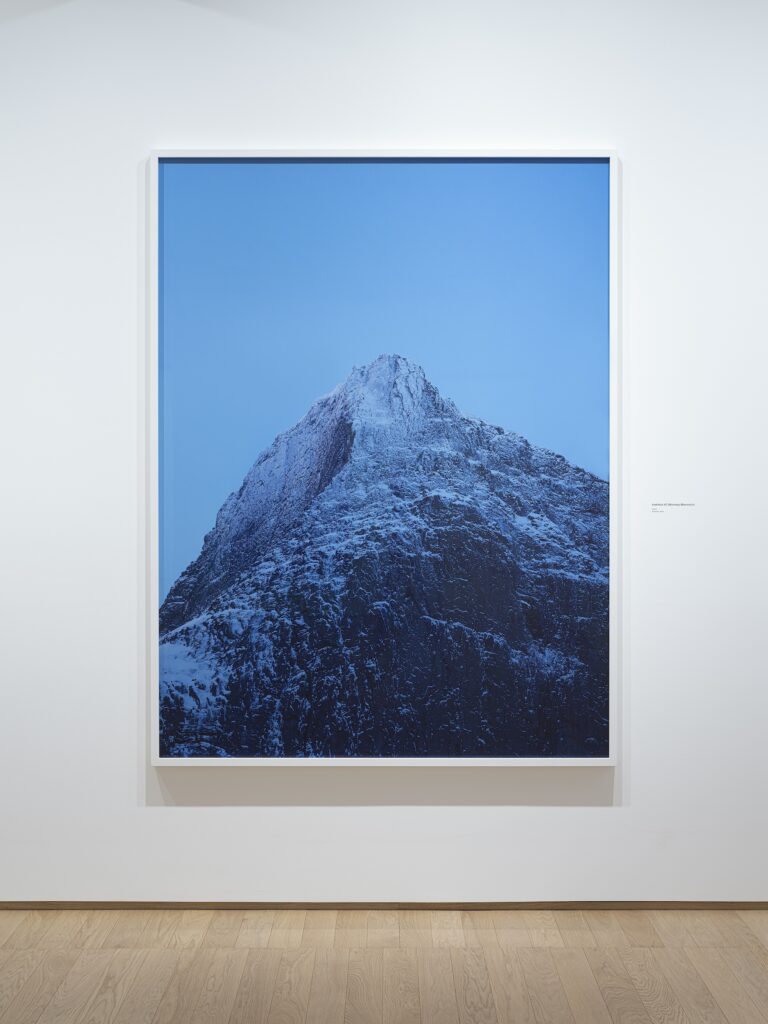
They’re equal to me. And that’s what I’m asking for, too: greater equality. Why do we think we’re more important than a mountain? That’s stupid. It’s harder to portray mountains than people, though. You can do a lot more with a person than with a mountain. You can move around a mountain, but you can’t ask a mountain to put their arm out and look at my finger to position their eyes. Portraits of people are so much more controlled as an idea. That’s why I spent five days in each location when photographing the mountains. I wasn’t just passing, I was getting to know them. I wanted these photos to be more about longing, than just a reaction to something that I passed. So how do we get that emotional quality embedded within the photograph? Well, it has to be embedded within me and the location, and the time.
I have done lots of hiking. I really loved the fourteen day backpacking hikes I used to do in California. I think that even though I travel by car now, I have spent enough time in these environments that one can only hike to, that it gives me an internal place for it.
You mentioned before that the mountain photographs have a healing quality to them?
Yes, they ask you to breathe.
A lot of your works are both personal and political. Would you consider these photographs that, too, and if so, in what way?
The personal is political, I’ve never been able to separate them.
But these works are maybe not as obviously political as your other works?
They’re political through my voice, but maybe not through merely looking at them. When I break down the body of work and the ideas that have come up, I lend my voice to the kind of politics I sympathize with. But it should also be possible to let go, and just contemplate the mountain. However, a mountain is definitely political today, in regards of rare earth and minerals etc.
What was your personal need to make these images?
My purpose was to fulfill an idea that I got fifteen years ago. When you come up with something as an artist, you should try and fulfill it. Because you don’t know where that journey will take you. If you think of something for fifteen years, there has to be something there.
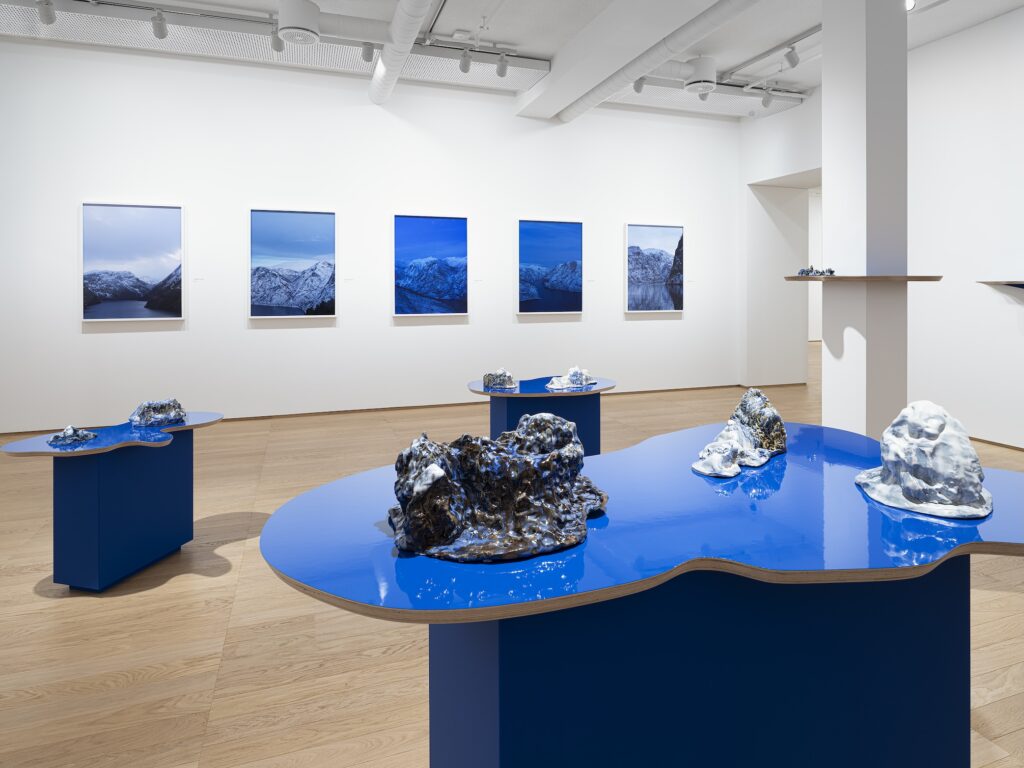
Speaking of trusting and following ideas and new techniques, you show ceramics. I guess it means that you’re a curious person, and you’re willing to take risks?
Yes I do! But you probably won’t see paintings by me, though. I think I need to invent a persona to be a painter, because I have such respect and love for painting as a medium. I am also always in conversation with the medium.
You have lots of painting references in your works?
Yes, and there even is a Richter in the Mountain Room! Meaning that there is one that easily could have been a Richter painting. I like to have conversations with other artists through my works.
I could see Hokusai?
Yeah, and Ed Ruscha, one of his mountains is in there too. But his mountains always had language on them.
How about the Norwegian Harald Sohlberg?
Yes, that’s where it all started. It happened when I was shown that painting (Vinternatt i Rondane), and was told that it’s very important as a symbol for Norwegians national identity. Then I thought, what is national identity? These mountains were here before it was a nation. What are our borders and boundaries, what are these things that we claim as someone’s national identity? Especially as I’ve watched my country melt down in the worst way ever. These are really important questions! But also in terms of conflicts in the world and even what’s going on in the Middle East, in the relationship to the idea that people can live together versus genocide. I’m not supposed to use that word in America but I’m here in Norway and I’m going to stay with genocide.
What is your relation to romantic artists, like Caspar David Friedrich?
Well, very much so the idea of enlightenment. One thing that I really love about Caspar David Friedrich is the idea that the church is the landscape. That’s a really interesting concept in the Age of enlightenment, in terms of how art really was the best campaign that the catholic church ever came up with. I view it as an incredible marketing campaign!
What about his ideas of the sublime experiences of nature?
I think nature is sublime, and I think it is our God. I think planet Earth is our God. We’re told that this was made in seven days. I didn’t grow up religious, but I had a crush on a girl in high school who was religious, so I became a reborn Christian for a few years. I went to bible camp and tried to figure out what this was all about. If a majority of the world believes that this is foundationally how everything was made, then I had better get some understanding about it.
When I needed to find a place for peace, as a child, I sat in a cornfield or on the edge of a lake. I always found peace in hiking our nature. By exploring and the act of leaving a city or a place allowed me a different introspective time. When I was in high school, you know my parents weren’t very parental, so I could leave for days by the time I got my car at 16. I could go away and nobody knew where I was. And I often just pitched a tent in the middle of the desert in Joshua Tree National Park, and sat and listened and watched the sky and breathed.
I’m very interested in the natural world as a place of wonderment. I was a camp council for many years, and taught riparian and forestry. And I feel that human beings have always controlled nature in a way that has been very unfortunate, and we’ve caused a lot of harm to it. I just want to think that this is the place that we should care for, and not abuse. This has been a way to enter a space in figuring out if representation of it also can create care. In the same way Lewis Hine was able to change child labour laws in the United States by photographing children working in those factories. Can I create a different ability for us to think about the times we are living in, through these different gestures?
And through that, make people do things differently?
Yes.
It seems you had serene moments there in the desert?
Yes, I really did. There’s so many artists from L. A. that ended up getting houses in Joshua Tree, there’s a huge artist community there. I chose Three Rivers, where nobody else was going.
How come?
Because of water, trees and rock. Sequoias! I’m at the edge of the National Sequoia forest. A 45 minute drive up the hill from my house I can walk in the forest of the largest trees in the world. My new persona was born out of a sequoia. She’s called The Lesbian Cowboy and is what I’m working on for the next body of work. No, I couldn’t live in the desert, I need water, I’m a water person.
Are you into astrology?
Well, yes I’m a triple aries, so I’m a fire sign. My sign is fire, fire, fire, but water is my favourite place in the world to be. The only time I feel comfortable in my body is when I’m swimming. But I think astrology is a very lesbianic thing, to tell you the truth. I grew up in a community of lesbians from the 70’s, and we’re all like mystical witchy poo, we all just enjoy our witchy poo nature. I like to think there’s other meanings out there.
For being an atheist, I think your works have many sacred qualities.
Yes, well my father raised me to be an atheist, but I don’t think I’m such an atheist after all. I’d like to think that there is something else than just this. In my twenties and thirties, I had experiences with losing so many friends from AIDS. For example my good friend Tony, who also was my neighbour in L. A. When he died I was unfortunately not with him, but got home before the memorial. In one of my dreams around that time, Tony came to me and he said ‘Cathy, I’m ok, and it’s ok that you weren’t here’. I woke up and felt really warm, and as soon as he said goodbye to me, my whole entire body got cold and I couldn’t stop shaking. I cannot explain that experience, but there was an energy, whether it be a dream or my own mind – something unexplainable happened. It made me realise that there is a way that energy carries on that I don’t really know about.
At the end of my father’s life he decided he wasn’t an atheist, but an agnostic. Because he believed that he remembered his other lives. He got through this meditation thing, where he got in touch with all of his past lives. But my father was also a pathological liar and liked to make stories up about UFOs and stuff, so who knows.
This experience you had in the desert, can you link that to the experience you had in the Norwegian mountains?
The road trip is different, because I wasn’t alone. If I had been alone, who knows what the body of work would have been? These works are very informed by the fact that a friend came with me who is a documentary film maker and actually had me talking about my process through the entire trip. I’ve never done this before. All my portraits are done in a silent studio with just me. Most things that I do are very solo. I’m a person who wants to be in my own head, and I find that this was a very interesting experience that I would like to try again with Kate. Without her, maybe I would have done only the blue mountains, and the Meditation Room and the Fjord Room. There wouldn’t have been the Vernacular or the Cliché Rooms, but the clay mountains I had started on before we went. The Vernacular and the Cliché Rooms are very interesting to think about internally discussing the process of photography in itself. And that, I haven’t done in other bodies of work, so that’s brand new to me. And I haven’t seen it finished until this week.
You have done landscape photography before, but in a different way. Will you continue doing it like this now?
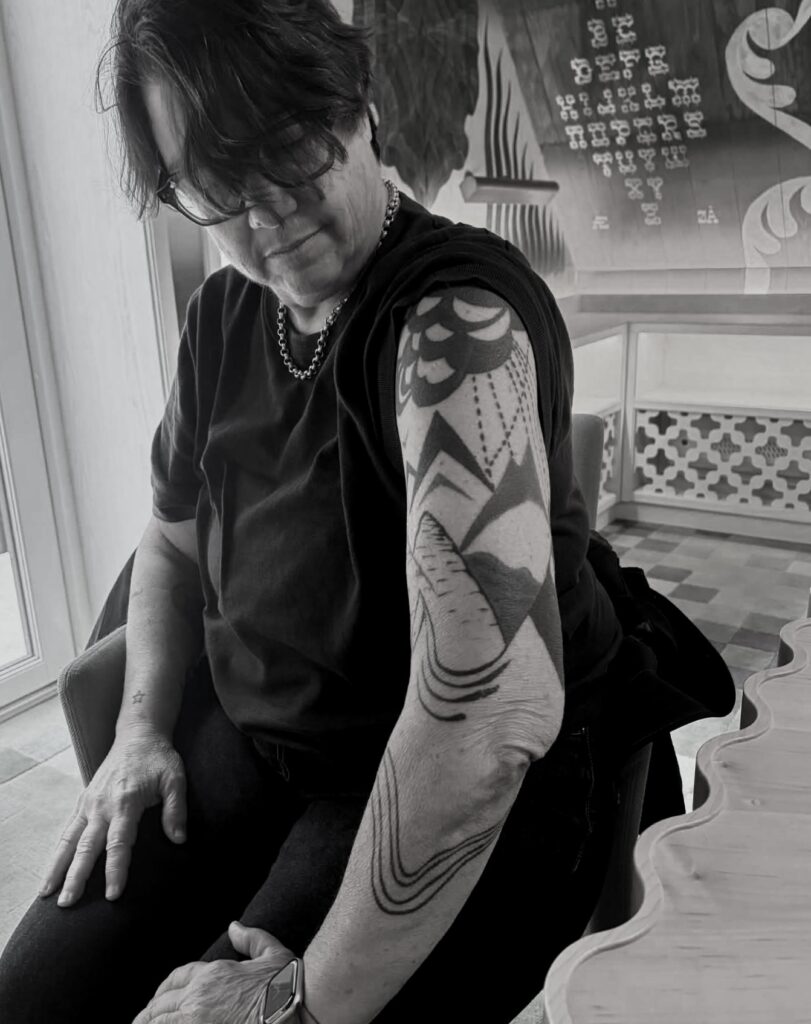
I wanna go to Japan. I’m really interested in the idea that if Norway’s mountains are the moment I’ve chosen around the identity of blue light, and Japanese culture holds their mountains for sacred and spiritual sites as if they are their churches. How does that language of culture get embedded in the way that I might experience their mountains, that’s a really good question. So no, I’m not done with mountains. Mountains are going to be a thing now! I even have lots of mountains tattooed on my arm! My best friend made them. They show where my home is, the Western Sierras, so it’s my home landscape. And I just made a drawing of The Lesbian Cowboy to be tattooed on some of the staff here at PoMo!
Since you’ve been teaching art students for 32 years, I’d like to finish off by asking you what general advice you would give to any young artists?
I started teaching in the 90’s, so I taught as different technologies emerged. What I’m looking at now in this younger generation that grew up with mobile phones, is that they don’t want hi tech gadgets. They want to know how to do things with their hands. My greatest hope right now is that I’ve raised enough money to rebuild an analogue darkroom at UCLA (University of California) and bring back all of that. The students are so thrilled to handle film.
Craft was such a bad word in the art world for so long, and I hated the idea that people didn’t care about craft. I care very much about how I make my work. Before, it was just about hyper intellectualizing, conceptualizing, all of that, which I really appreciated as a format within the dialogue of criticism and art history. But at the same time, we scared people off from making. Now, we’ve gotten back to the young people wanting to make. So just keep making – everybody! That’s my advice. Make, make, make, make! The thing that I kept telling my students, and it drove them crazy, was ‘Guys, the tool box! Make your tool box big. At every aspect of your medium. Because that’s how you can change your work, if you want a mood or a moment to change, but you don’t know technically how to achieve that, then your tool box isn’t big enough.’ They even made me a t-shirt with a tool box on it!
Catherine Opie
Mountains Don’t Know their Names
June 25th 2026–January 3th 2027
PoMo